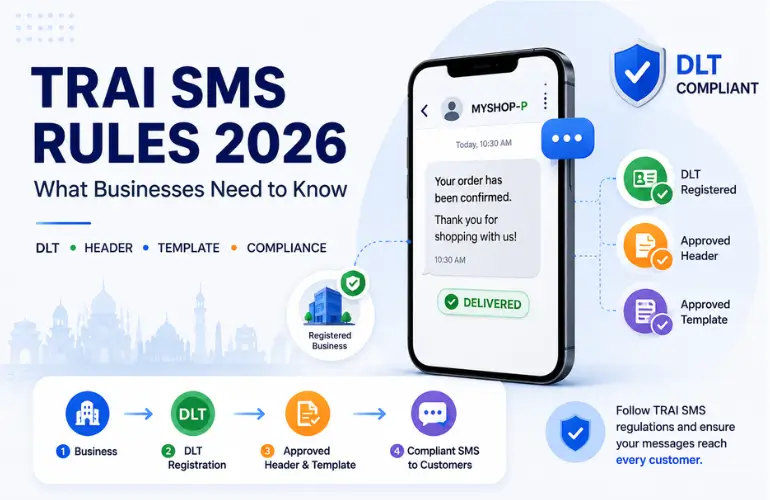
A bulk SMS campaign can fail even when the SMS gateway is working. A sender header may not be registered correctly, the content may not match the approved template, or the message may be classified incorrectly. When an SMS fails the operator's compliance checks, it may not be delivered, leaving businesses to determine whether the problem is their content, DLT setup or messaging provider.
The TCCCPR framework dates back to 2018, but TRAI and telecom operators have continued to refine its implementation. The 2025 header-suffix change and the March 10, 2026 migration of Service Explicit templates into the Promotional category are two developments businesses should understand when reviewing their SMS setup.
What do Indian businesses need to know about TRAI SMS regulations in 2026? Businesses sending bulk communication need to follow the applicable TCCCPR requirements, including Principal Entity registration, header and content-template registration, and consent requirements where applicable. Current implementation also includes message-category suffixes on headers and the migration of Service Explicit templates into the Promotional category from March 10, 2026.
What Are TRAI SMS Regulations in India?
The Telecom Regulatory Authority of India regulates commercial SMS through the Telecom Commercial Communications Customer Preference Regulations (TCCCPR), first introduced in 2018 and amended since. The underlying goal is simple: stop unsolicited commercial communication (UCC) - the "win a lottery" and "get an instant loan" spam that used to flood Indian phones - while still letting legitimate businesses reach customers reliably.
To do this, TRAI built a system where every sender has to be identifiable and every message has to be traceable back to a verified business. That's where DLT comes in.
What Is DLT in Bulk SMS?
DLT stands for Distributed Ledger Technology. In India's SMS ecosystem, telecom operators use DLT-based systems to maintain standardized, traceable records for entities, headers and content templates. In practice, the compliance setup involves:
- Principal Entity (PE): the verified business identity registered on the DLT platform.
- Sender ID / Header: the short code or name customers see as the sender (e.g., "AXBANK" or "MYSHOP").
- Content Template: the exact, pre-approved wording your SMS must match.
- Consent: customer consent where required by the applicable message category and regulatory framework.
Before delivery, commercial SMS is scrubbed against the relevant registered information. TRAI states that if a commercial SMS fails the content-template check, it is not allowed to be delivered to the consumer.
This article focuses on the regulatory picture, not the registration walkthrough. If you haven't registered yet, YourBulkSMS has a detailed DLT registration guide that covers the platform-by-platform steps.
Why Do TRAI SMS Regulations Matter for Businesses?
Why does DLT compliance matter for bulk SMS? Because a message that fails the applicable DLT or content checks may be blocked before it reaches the recipient. Compliance is therefore directly connected to delivery reliability, not just paperwork.
The practical impact can include:
- Failed OTPs during login or checkout.
- Campaign delivery failures caused by header or template mismatches.
- Template rejections after unregistered content changes.
- Header confusion when multiple sender IDs are not correctly mapped.
What Should Businesses Know About TRAI SMS Regulations in 2026?
The core DLT framework remains in place in 2026. Two implementation developments are particularly relevant to businesses reviewing their SMS setup:
1. Message-category suffixes are in use. Under the 2025 amendment to TCCCPR, Access Providers were directed to add category suffixes to headers: "-P" for promotional, "-S" for service, "-T" for transactional and "-G" for government messages. The suffix is applied by the telecom operator based on the message category during the DLT process; businesses do not manually add it to their registered header.
2. Service Explicit templates moved into Promotional. The 2025 amendment provides for Service Explicit templates to be migrated into the Promotional category from March 10, 2026. Businesses that previously used Service Explicit templates should now review their DLT records and confirm that their current templates and message classifications are correct.
These changes do not replace the wider TCCCPR framework. Businesses should review their current headers, templates and message classifications rather than assuming an older DLT setup is still correct.
What Are the Different Types of Business SMS?
Promotional SMS
Promotional SMS covers marketing communication such as offers, discounts, sales announcements and event promotions. Promotional communication is subject to the recipient's registered preferences and applicable consent requirements. If explicit digital consent has been acquired under the regulations, the framework provides for promotional communication even where the recipient's applicable preference would otherwise block it. Promotional messages must use the appropriate registered header and content template.
See also: Promotional Bulk SMS
Transactional SMS
Transactional SMS covers messages sent in response to a customer-initiated transaction, such as eligible OTPs, transaction alerts, confirmations and refund information. Under the current definition, a transactional message is tied to a customer-initiated transaction and is sent within 30 minutes of that transaction. Transactional communication still falls within the DLT framework and must use the required registered information and templates.
See also: Transactional SMS
OTP SMS
OTP SMS is commonly used for authentication, including login verification, sign-up codes and eligible transaction-related verification. TRAI's current definition includes OTPs among examples of transactional messages. Businesses should not assume that labelling a message as an “OTP” makes it transactional; the message must actually meet the applicable definition and use the required registered setup.
See also: OTP SMS Service
Service / Informational SMS
Service messages cover eligible non-promotional information related to a product or service, such as warranty or recall information, software upgrades, safety or security information, delivery information and other communications covered by the applicable TCCCPR definition. Because Service Explicit templates were migrated into Promotional from March 10, 2026, businesses should review any older template classifications.
What Are the Key DLT Requirements for Businesses?
Principal Entity Registration
Businesses using telecom resources for bulk communication must complete the applicable Principal Entity registration with an Access Provider. TRAI's current sender guidance lists Principal Entity registration as a required step for senders of OTP, transactional, service and commercial bulk communication.
SMS Header / Sender ID Registration
A header is the alphanumeric identifier assigned to a sender for commercial communication. It must be registered under the Principal Entity, and the message must use the appropriate registered header and category. TRAI's current guidance states that commercial communication is carried through registered headers.
Content Template Registration
Businesses need to register the structure of their message content, including fixed and variable parts, through the relevant telecom operator. Commercial SMS is scrubbed against registered content templates, and a message that fails the applicable template check may not be delivered.
Consent Requirements
Consent requirements depend on the message category and applicable regulatory provisions. For commercial communication where consent is required, businesses should retain appropriate records showing how and when the recipient provided consent.
Entity, Header and Template Mapping
The three pieces above only work together if they're correctly linked: the right header under the right entity, sending only the templates approved for that header's category. A common failure point is businesses reusing a transactional header for promotional content, which gets flagged and blocked.
How Does DLT Registration Work?
A high-level view of the process:
- Register your business as a Principal Entity on a telecom operator's DLT platform.
- Complete KYC/document verification for the entity.
- Register your sender ID(s)/header(s) under the approved entity.
- Submit your content templates for each message category you'll use.
- Complete consent-related documentation for applicable message types.
- Map your approved Entity ID, headers, and templates with your SMS service provider.
- Begin sending - messages are checked against this registered setup on every send.
For the full step-by-step walkthrough, including operator-specific portals and document requirements, see YourBulkSMS's DLT registration guide.
Need help with DLT registration and SMS setup? Talk to YourBulkSMS.
What Are DLT Registration Charges in India in 2026?
DLT registration charges can be confusing because the regulatory framework and commercial fees are not the same thing. The key distinction is:
- TRAI sets the regulatory framework. Its current sender guidance does not publish one universal “TRAI DLT registration fee.”
- Access Provider/TSP platforms handle DLT registration. Any applicable operator charges or processes can differ by platform and may change.
- SMS providers may charge for support or managed DLT services. These are separate from regulatory requirements and should be identified clearly in a quotation.
Because fees and commercial terms can change, verify the current charge, if any, with the relevant DLT platform or SMS provider before publishing a price. Avoid presenting a provider's fee as an official TRAI charge.
What Happens If SMS Is Not Compliant?
Non-compliant SMS typically runs into one or more of the following:
- Message rejection at the operator level - the SMS simply doesn't get delivered, with no retry.
- Header/template mismatch failures, where content doesn't match what's registered.
- Filtering or blocking by the telecom operator.
- Further action by the Access Provider in cases covered by the regulations, which can include suspension or disconnection of telecom resources for unregistered commercial senders.
What happens if a business sends SMS without following DLT requirements? A commercial message that does not meet the applicable registration or scrubbing requirements may not be delivered. For businesses, that can translate into failed OTPs, missed alerts and wasted campaign spend. Compliance should therefore be treated as part of reliable SMS delivery.
How Different Industries Use Compliant SMS
Banking & Financial Services
OTP, eligible transactional alerts and account notifications.
E-commerce & Retail
Order updates, delivery alerts, OTPs and promotional campaigns.
Healthcare
Appointment reminders, report notifications and patient-portal OTPs.
Education
Student/parent alerts, fee reminders, schedules and login OTPs.
Real Estate
Eligible customer updates plus promotional campaigns for property launches and offers.
IT & SaaS
Account notifications, authentication OTPs and transactional alerts.
Logistics, Travel & Other Businesses
Booking confirmations, delivery updates, reminders and promotional communication where applicable.
How Can Businesses Stay Compliant With TRAI SMS Regulations?
How can businesses stay compliant when sending bulk SMS? The short answer: keep your entity, headers, and templates accurate and up to date, and don't let content drift from what's registered. In practice:
- Keep Principal Entity details current, especially after any business name, address, or ownership change.
- Use only registered sender IDs/headers for the categories they're approved for.
- Match outgoing content exactly to approved templates, including variable fields.
- Maintain consent records for promotional communication.
- Classify each message correctly - don't default everything to "transactional" to bypass promotional restrictions.
- Review your current templates after the March 10, 2026 Service Explicit-to-Promotional migration.
- Work with a provider that flags rejections and mismatches rather than just reporting "sent."
- Monitor delivery and rejection reports regularly, not just after a campaign fails.
- Review current TRAI and Access Provider updates when changing your messaging setup or templates.
How to Choose a Bulk SMS Service Provider in India
Your SMS provider should make compliance and delivery easier to manage. Look for:
- DLT compliance support - does the provider help you register and maintain entity/header/template mapping, or leave you to manage it alone?
- Delivery reliability across telecom operators.
- API integration for OTPs, alerts and other automated messages.
- Real-time delivery reports with rejection visibility.
- Scalability for campaigns and transactional traffic.
- Responsive support for header and template issues.
- Promotional, transactional and OTP SMS from one platform.
- Transparent pricing that separates provider and operator charges.
Why Choose YourBulkSMS?
YourBulkSMS provides DLT-compliant business messaging solutions across promotional, transactional and OTP SMS, along with API integration, dashboard-based reporting and support. The company's website also highlights fast message delivery, high uptime, real-time reports and dedicated support.
Explore the specific services: Bulk SMS, OTP SMS, Transactional SMS, Promotional SMS, and the DLT Registration guide.
Get Started With Compliant Business Messaging
Sending promotional campaigns, transactional alerts or OTPs in 2026 still requires businesses to work within the TCCCPR framework and their Access Provider's DLT processes. Keeping entity, header and template information accurate - including the changes following the March 10, 2026 Service Explicit migration - helps reduce avoidable delivery failures.
If you'd rather not track every regulatory update yourself, YourBulkSMS can help you manage business messaging with the compliance and technology setup already handled. Talk to YourBulkSMS or Book a Free Demo.
FAQs
Que.1 What are the TRAI SMS regulations in India in 2026?
Ans. Businesses sending bulk communication must complete the applicable Principal Entity, header and content-template requirements. In 2026, message headers also use category suffixes, and Service Explicit templates have been migrated into the Promotional category from March 10, 2026.
Que.2 Is DLT registration mandatory for bulk SMS in India?
Ans. For bulk commercial communication, the applicable DLT registration requirements must be completed. TRAI's current sender guidance lists Principal Entity registration, header assignment and content-template registration for senders of OTP, transactional, service and commercial bulk communication.
Que.3 What is DLT registration for SMS?
Ans. It is the process of registering the Principal Entity, sender header and content templates through an Access Provider's DLT platform so the telecom network can apply the required verification and scrubbing process to bulk communication.
Que.4 What are DLT registration charges in India?
Ans. There is no single universal fee published in TRAI's current sender guidance. Any applicable operator or provider charges should be verified with the DLT platform or SMS provider you use.
Que.5 Is DLT registration required for OTP SMS?
Ans. OTP messages are included among examples of transactional messages in the current TCCCPR definition. Businesses still need to follow the applicable Principal Entity, header and content-template requirements; the exact treatment depends on whether the message meets the regulatory definition of a transactional message.
Que.6 What is an SMS header or sender ID?
Ans. A header is an alphanumeric identifier assigned to an individual, business or legal entity for commercial communication. TRAI states that commercial communication is carried through registered headers.
Que.7 What is a DLT content template?
Ans. It is the registered structure of an SMS containing its fixed and variable parts. Telecom operators scrub commercial SMS against registered content templates before delivery.
Que.8 What are the rules for promotional SMS in India?
Ans. Promotional SMS must follow the applicable registered header, content-template and recipient-preference/consent requirements. TRAI's current framework provides that promotional communication is delivered according to the recipient's registered preferences or applicable consent provisions.
Que.9 What are the rules for transactional SMS?
Ans. Transactional messages are defined around customer-initiated transactions and do not require explicit consent under the current definition. They still need to follow the applicable DLT registration and content-template requirements.
Que.10 What happens if an SMS does not match the approved DLT template?
Ans. TRAI states that commercial SMS that fails scrubbing against the registered content template is not allowed to be delivered to the consumer.
Que.11 Can businesses send bulk SMS without DLT compliance?
Ans. Businesses should not send bulk commercial SMS outside the applicable DLT and TCCCPR requirements. TRAI states that an unregistered sender cannot make commercial communication through Access Provider networks.
Que.12 How can businesses stay compliant with TRAI SMS regulations?
Ans. Keep entity and header details current, use registered templates, classify messages correctly, maintain consent records where required, and review your DLT setup after regulatory or operator changes such as the March 10, 2026 Service Explicit migration.
Que.13 How should a business choose a DLT-compliant bulk SMS service provider?
Ans. Look for strong DLT compliance support, reliable multi-operator delivery, clear rejection reporting, API access for transactional use cases, and transparent pricing that separates operator charges from provider fees.
Conclusion
TRAI's SMS regulations exist to keep commercial messaging traceable and spam-free - and in 2026, that means going a step further than basic DLT registration. Entity registration, correct headers, matching templates, and documented consent are still the foundation, but businesses now also need to account for automatic header suffixes and the Service Explicit-to-Promotional migration landing in March 2026. Get the entity-header-template mapping right, keep it current, and work with a provider that actually flags problems instead of just reporting "sent."
Ready to simplify compliant business messaging? Talk to YourBulkSMS and get your DLT setup, sender IDs, and templates handled the right way.


.webp)
.webp)