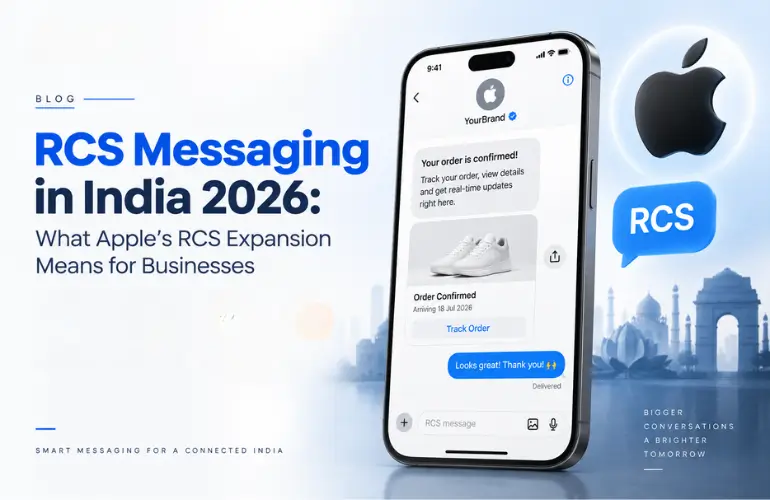
For years, RCS in India meant one thing: Android. iPhone users fell back to plain SMS - no rich media, no branded sender, no interactive buttons. That gap shaped how businesses planned messaging campaigns, often writing off a meaningful chunk of their audience by default.
That gap has been closing. Apple brought RCS support to iPhone starting with iOS 18, enabled in India through carrier partnerships led by Jio. Then in May 2026, Apple began rolling out end-to-end encrypted RCS messaging in beta with iOS 26.5 - a security upgrade that brings iPhone's RCS experience closer to parity with Android, though the rollout still depends on carrier support and is expanding gradually rather than switching on everywhere at once.
For Indian businesses, this isn't a footnote. It changes how much of your customer base can actually receive a rich, branded RCS message instead of a bare SMS. This article looks at what's changed, what it means practically, and how to decide if RCS deserves a place in your messaging stack this year.
Quick Answer: What Does Apple's RCS Expansion Mean for Businesses?
Apple introduced RCS support on iPhone with iOS 18, while availability depends on carrier support. In India, RCS availability and business messaging reach continue to develop across supported networks. Apple's 2026 rollout of end-to-end encrypted RCS messaging is a separate development that further expands the capabilities of RCS on supported devices.
For businesses, this closes the long-standing Android-only limitation of RCS in India. Campaigns that once reached only Android users can now reach a much larger combined audience, making RCS a more viable channel for order updates, OTPs, and marketing - alongside, not necessarily instead of, SMS and WhatsApp.
What Changed for RCS Messaging in India in 2026?
RCS Is Expanding Beyond the Android Ecosystem
RCS launched in India as an Android-first channel, built on Google's Jibe platform and adopted early by Jio, Airtel, and Vi. iPhone users were excluded by design - Apple's Messages app relied on iMessage for rich features and fell back to SMS for everyone else.
That changed with iOS 18, when Apple added native RCS support. In 2026, Apple also began rolling out end-to-end encrypted RCS messaging in beta with iOS 26.5. Availability remains dependent on device and carrier support.
What Apple's RCS Expansion Means for Indian Businesses
The practical shift is reach. Historically, an RCS campaign in India could only count on Android subscribers responding to rich formatting - iPhone users always saw a fallback SMS. With RCS support (and now encryption) rolling out on iPhone, that ceiling is rising. Businesses no longer have to treat "does my audience use Android or iPhone" as a hard constraint when deciding whether RCS is worth using.
That said, actual RCS availability still depends on the recipient's device, carrier and network support. Businesses should treat it as an expanding channel rather than a universally available one.
Why 2026 Matters for Business Messaging
2026 is the year RCS in India stopped being a single-platform bet. Between wider carrier support, Apple's continued RCS investment, and the added trust signal of end-to-end encryption, RCS is shifting from "worth testing on Android" to "worth evaluating as a mainstream channel." For businesses that shelved RCS earlier because of iPhone exclusion, this is a reasonable point to revisit that decision.
What Is RCS Messaging for Businesses?
RCS (Rich Communication Services) is a messaging standard that adds richer, interactive capabilities to traditional text messaging, including supported rich media, suggested actions, read receipts, typing indicators, and branded business messaging.
For businesses, RCS Business Messaging (RBM) means sending these rich messages through an approved sender profile, typically via a messaging provider that handles carrier connections, verification, and delivery.
This article focuses on what's changed in 2026 and what it means for decision-making. For a full breakdown of RCS features, setup, and fundamentals, see our complete guide to RCS for Business and our earlier look at the rise of RCS messaging in India.
RCS Messaging vs SMS: What Changes for Businesses?
RCS isn't automatically "better" than SMS for every use case - it changes what's possible, and that only matters if your use case benefits from it.
| SMS | RCS Messaging | |
|---|---|---|
| Rich media | Text only (MMS is limited and inconsistent) | Images, video, carousels |
| Buttons/interaction | None - reply by texting back | Suggested replies, quick-action buttons |
| Branding | Generic sender ID/number | Verified business name, logo |
| Read receipts | Not available | Available |
| Analytics | Delivery status only | Delivery, read, and interaction data |
| Customer experience | Functional, plain | Visual, interactive |
| Universal reach | Works on every phone, every network | Depends on device and carrier RCS support |
| Fallback | N/A | SMS fallback can be used when RCS isn't available, depending on the provider and setup |
Where RCS gives a real advantage: order tracking with visual status, product carousels for marketing, appointment booking with tap-to-confirm buttons, and any message where a customer taking an action (confirm, reschedule, browse) matters more than just reading text.
Where SMS still holds up: simple, urgent messages where broad device and network reach matters - such as OTPs and critical alerts. SMS remains useful for customers or situations where RCS is unavailable.
Most businesses end up using both - RCS where richness adds value, SMS as the dependable fallback.
What Does Apple's RCS Expansion Mean for Business Messaging?
More Opportunities to Reach iPhone Users
Campaigns that once split into "rich experience for Android, plain text for iPhone" can now plan for a more consistent experience across both, as more iPhone users come online for RCS through carrier rollouts.
Richer Customer Experiences Inside Messages
A logistics company sending a delivery update can now show a package image and a "Track Order" button to a larger share of its customer base, rather than reserving that experience for Android users only.
Native Messaging as a Business Channel
RCS runs inside the phone's default messaging app - no app download, no opt-in friction beyond a normal text message. As iPhone support matures, this native channel becomes credible for both platforms without asking customers to install anything.
RCS as Part of an Omnichannel Strategy
RCS growing on iPhone doesn't replace WhatsApp, email, or SMS - it adds a channel that can now reach more of the phone-based audience Indian businesses already message daily. The practical move is deciding which messages benefit from RCS's format and building it into an existing SMS/WhatsApp mix rather than treating it as a standalone strategy.
How Businesses Can Use RCS Messaging in India
Ecommerce & D2C
Problem: Order and delivery updates sent as plain SMS get ignored or feel impersonal.
How RCS helps: Visual order confirmations, product images, and a "Track Order" or "Rate Your Purchase" button inside the message.
Example: An online fashion retailer sends a delivery-day RCS message with a photo of the package and a one-tap "Confirm Delivery" button.
Banking & Fintech
Problem: Transaction alerts and service messages are plain text, and customers can't act on them directly.
How RCS helps: Branded, verified sender identity (reducing phishing confusion) plus buttons for actions like "View Statement" or "Report Issue."
Example: A bank sends a card transaction alert with a verified sender badge and a "This wasn't me" button for instant fraud reporting.
Travel & Hospitality
Problem: Booking confirmations and itinerary updates are hard to reference later in a plain SMS thread.
How RCS helps: Rich boarding-pass style confirmations, check-in reminders with a direct action button.
Example: An airline sends a check-in reminder 24 hours before departure with a "Check In Now" button and flight details laid out visually.
Healthcare
Problem: Appointment reminders sent as SMS have no easy way for patients to confirm or reschedule.
How RCS helps: Appointment cards with confirm/reschedule buttons, reducing no-shows and phone-line load.
Example: A diagnostic lab sends a report-ready notification with a "View Report" button linking to a secure patient portal.
Retail
Problem: Promotional SMS blasts are plain text and easy to skim past.
How RCS helps: Product carousels showing multiple items, store location buttons, and visually distinct offers.
Example: A retail chain sends a festive-sale RCS message with a swipeable carousel of top offers and a "Shop Now" button.
Education
Problem: Admission updates and fee reminders sent as plain text get lost among other messages.
How RCS helps: Branded sender identity builds trust, and action buttons let students or parents respond directly.
Example: An institute sends an admission-status update with a "Complete Your Application" button linking straight to the portal.
RCS Messaging vs WhatsApp Business API: Which Is Better?
Neither is a universal winner - they solve overlapping but different problems.
| RCS Messaging | WhatsApp Business API | |
|---|---|---|
| Where it lives | Native default messaging app | Separate app (WhatsApp) |
| Requires customer app/account | No - works if the phone/carrier supports RCS | Yes - customer must have WhatsApp installed |
| Reach in India | Growing, expanding to iPhone in 2026 | Very high WhatsApp penetration already |
| Fallback if unsupported | Automatic SMS fallback | No fallback - delivery fails if not on WhatsApp |
| Rich media & buttons | Yes | Yes |
| Marketing templates | Provider/carrier-dependent approval | Meta template approval required |
| Best fit | Reaching customers without assuming an app is installed | Reaching an audience already active on WhatsApp |
When RCS makes more sense: when you want a native messaging channel with SMS fallback available through the relevant setup.
When WhatsApp makes more sense: when your audience is already highly active on WhatsApp and you want two-way conversational support, not just outbound notifications.
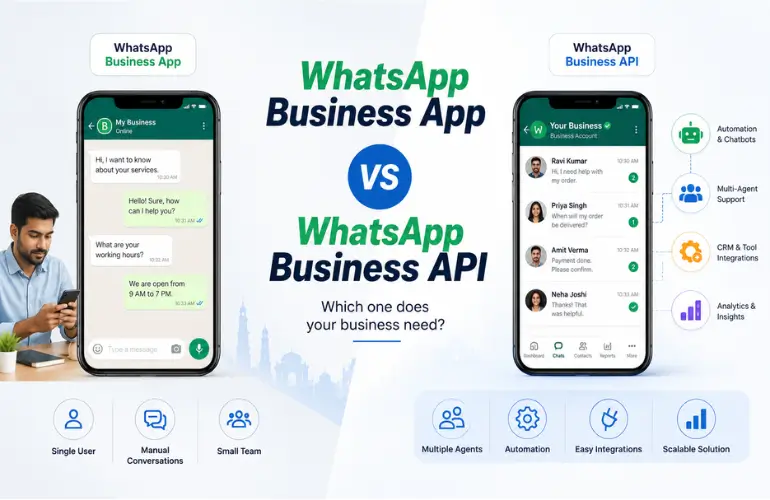
When to use both: many businesses run WhatsApp for conversational support and marketing where customers opt in, while using RCS (with SMS fallback) for transactional messages where guaranteed delivery matters more than which app the customer prefers. If you're weighing this decision for your own stack, our guide on WhatsApp Business API covers that channel in more depth.
How Much Does RCS Messaging Cost in India in 2026?
There's no single flat "RCS price" - cost depends on several factors, and this is worth checking with your provider directly rather than assuming a fixed number.
Message type: Transactional/utility RCS messages (order updates, OTPs, alerts) are typically priced differently from promotional/marketing RCS messages, similar to how SMS and WhatsApp separate these categories.
Carrier/network: Pricing can vary depending on which carrier the recipient is on, since RCS delivery runs through carrier infrastructure and partnerships (Jio, Airtel, Vi) rather than a single unified network.
Volume: Higher-volume senders typically get better per-message rates from providers, similar to bulk SMS pricing structures.
Promotional vs transactional communication: Promotional RCS campaigns are usually priced higher than transactional/utility messages, and promotional sends are also subject to consent and regulatory requirements in India (similar to DLT rules for promotional SMS).
Provider and billing model: Your RCS messaging provider adds its own platform fee on top of carrier costs, and billing models can be per-message or volume-slab based depending on the provider.
iPhone expansion factor (2026): As Apple's RCS support (including the iOS 26.5 encryption rollout from May 2026) extends reach to more iPhone users, expect providers to reference this expanded reach in their plans - but exact updated rate cards vary by provider and should be confirmed directly rather than assumed from older pricing pages.
Given how carrier-dependent and provider-specific RCS pricing is, the most reliable step is requesting a current quote based on your expected message mix and volume rather than relying on a generic number.
Is RCS Messaging Worth It for Indian Businesses in 2026?
RCS is a good fit when:
- You send order updates, appointment reminders, or account alerts where a visual, interactive format improves the customer's ability to act
- You want a native-app channel that doesn't depend on customers installing anything
- You already send high-volume SMS and want to upgrade select message types without abandoning SMS reliability
- Your audience includes both Android and iPhone users and you don't want to design two separate experiences
RCS may not be necessary yet if:
- Your message volume is low and plain SMS already gets the job done
- Your audience is concentrated on WhatsApp and conversational engagement matters more than rich notifications
- You're not ready to manage a second channel's templates and approval process alongside existing SMS/WhatsApp workflows
The practical framework: start with your highest-volume, highest-impact message types (order updates, appointment reminders, OTPs) and evaluate RCS there first, rather than converting your entire messaging stack at once.
How to Start Using RCS Messaging in India
- Define your use case - pick the message types (transactional, promotional, or both) you want to move to RCS first.
- Evaluate audience/reach - check what portion of your customer base is likely to be RCS-capable (carrier and device), keeping in mind SMS fallback covers the rest.
- Choose a provider - select an RCS messaging provider with carrier connections and a track record in India.
- Complete required setup - business verification and sender profile approval with the provider/carrier.
- Create messages/templates - design rich message formats (images, buttons, carousels) suited to each use case.
- Integrate - connect the RCS API to your order system, CRM, or notification pipeline.
- Test - send to a small audience segment first and confirm rendering across Android and iPhone.
- Launch and measure - roll out fully and track delivery, read, and interaction data to refine future messages.
How to Choose the Right RCS Messaging Provider in India
- Reach/network availability - confirm the provider has active RCS connections with major Indian carriers (Jio, Airtel, Vi), not just a single network.
- API/integration - check how easily the RCS API connects to your existing CRM, order system, or notification pipeline.
- Business setup support - a provider that handles sender verification and profile approval smoothly saves real onboarding time.
- Templates - look at how templates are created, reviewed, and approved, and how quickly changes can go live.
- Analytics - delivery, read, and interaction reporting should be accessible, not buried or unavailable.
- Scalability - the provider should handle both a small pilot and a full-volume rollout without a platform change.
- Support - responsive support matters when a campaign needs troubleshooting or a template gets rejected.
- Pricing transparency - carrier costs and provider fees should be shown clearly, not bundled into a vague flat rate.
Why Choose YourBulkSMS for RCS Messaging?
YourBulkSMS provides RCS messaging service alongside bulk SMS, OTP SMS, transactional and promotional SMS, voice SMS, and WhatsApp Business API - so businesses can manage RCS as part of an existing messaging setup rather than adding a completely separate vendor relationship.
For businesses evaluating RCS for the first time, this can make it easier to use richer message formats where they add value while continuing to use SMS for messages where broader reach is important.
Get RCS Messaging Pricing →
Frequently Asked Questions About RCS Messaging
What is RCS messaging?
RCS (Rich Communication Services) is a modern messaging standard that upgrades SMS with images, buttons, read receipts, and branded sender identity, delivered through the phone's native messaging app.
Is RCS messaging available on iPhone in India?
Yes, with growing availability. Apple added RCS support starting with iOS 18, rolled out in India through carrier partnerships, and extended it further with end-to-end encryption in iOS 26.5 starting May 2026. Availability still depends on carrier and device support.
How does RCS messaging work for businesses?
Businesses send RCS messages through an approved sender profile via a messaging provider, which connects to carrier networks and delivers rich, interactive messages to supported devices, falling back to SMS when RCS isn't available.
Is RCS better than SMS?
Not universally - RCS adds rich media and interactivity that improve engagement for messages where action matters (order tracking, bookings), while SMS remains more universally deliverable for simple, urgent messages.
RCS messaging vs WhatsApp: which is better?
It depends on the use case. RCS works without requiring a separate app and falls back to SMS if unsupported; WhatsApp requires the customer to have the app but offers strong two-way conversational engagement where adoption is high.
How much does RCS messaging cost in India?
Cost depends on message type (transactional vs promotional), carrier, volume, and provider fees - there's no single fixed price, so get a current quote based on your specific use case.
Can businesses send promotional messages through RCS?
Yes, with proper approval and consent requirements, similar to promotional SMS regulations in India.
Can RCS messaging be used for OTPs?
RCS can carry OTP-style messages, but many businesses still rely on SMS for OTPs specifically because of its universal deliverability across every device and network condition.
Does RCS require a separate app?
No - RCS runs inside the phone's default messaging app on supported devices and carriers.
What happens if a customer cannot receive RCS?
The message automatically falls back to standard SMS, so delivery isn't lost - the customer just receives a plain-text version instead of the rich format.
How can a business start RCS messaging in India?
By defining a use case, choosing an RCS messaging provider, completing business verification, building templates, integrating with existing systems, and testing before a full rollout.
The Future of RCS Messaging in India
RCS in India is moving toward broader cross-platform availability, with Apple's continued investment in RCS adding momentum in 2026. For businesses, the practical shift is reach: the audience RCS can realistically serve is larger and less platform-dependent than it was even a year ago.
That doesn't mean replacing SMS or WhatsApp - it means RCS has become a credible option to add where richer, interactive messaging genuinely improves the customer experience.
If you're evaluating whether RCS fits your messaging mix, talk to the YourBulkSMS team for current pricing and setup guidance based on your use case.
Talk to an RCS Messaging Expert →


.webp)
.webp)